Cashews look the same in most shops. Same pale colour, same curved shape, same general size. But anyone who has bought them in bulk, imported them, or sourced them for a food business knows there is a grading system behind every bag, and that system changes the price, the presentation, and the application significantly. W180, W240, W320, these codes appear on every professional cashew invoice and export document, yet most buyers have never had them properly explained. A Natural whole Cashew nut grade tells you exactly how large the kernel is, where it fits in the quality hierarchy, and what it is best used for. This article breaks down every grade in simple language, including the W240 cashew nut and W320 cashew nut varieties that dominate global trade, so you can make informed decisions whether you are buying for home, for a food business, or for export.
Where Do Cashew Grades Come From?
Cashew grading follows an international standard set by the Cashew Export Promotion Council of India (CEPCI) and is widely adopted across global trade.
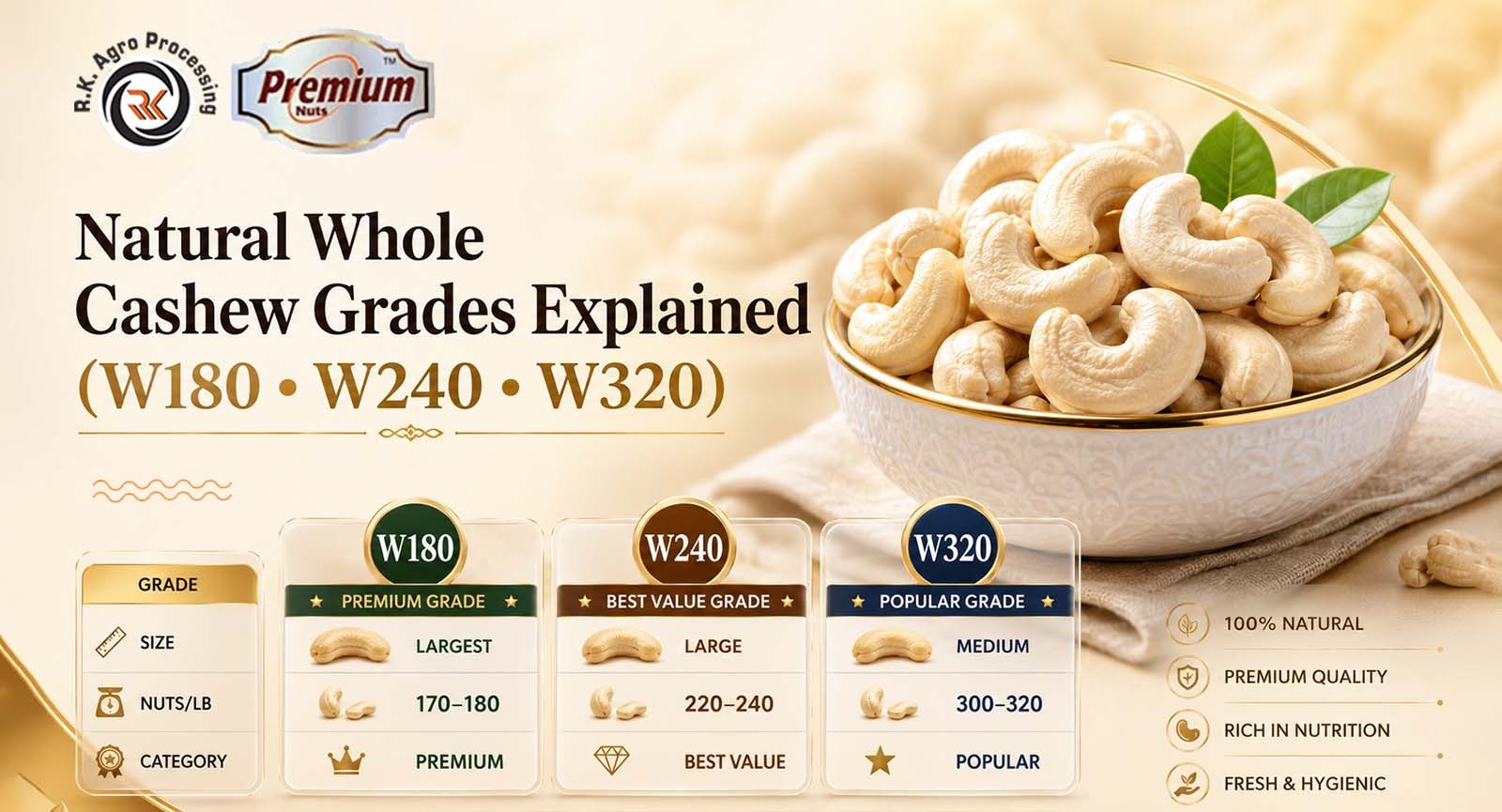
The grading system is based on count per pound. One pound equals approximately 454 grams. A bag of W180 cashews contains around 180 whole kernels per pound. A bag of W320 contains around 320. That difference in count directly tells you the size, bigger nuts, smaller count. Smaller nuts, higher count.
The “W” in the variety of natural whole cashew nuts stands for White or Whole. It means the kernel is intact, unbroken, and has the white or pale ivory colour that comes from proper processing. These are the premium grades, the ones that go into retail packaging, gifting, and high-end food production.
India is the world’s largest processor of cashew nuts, accounting for nearly 60% of global cashew processing. That makes Indian grading standards effectively the benchmark for the entire industry.
W180 Cashew Nut: The Largest Grade
What It Is?
W180 is the biggest commercially available natural whole cashew nut grade. Around 180 kernels fit into a pound, which means each nut is noticeably large, bold, plump, and visually striking.
Who Buys It and Why?
W180 cashews are considered a premium product. They command the highest price per kilogram of any whole grade and are typically found in:
- Luxury gift boxes and premium dry fruit hampers
- High-end confectionery and chocolate production
- Five-star hotel buffets and fine dining kitchens
- Export markets in the Middle East and Europe, where large-kernel cashews are in high demand
The W180 cashew nut is sometimes called the “elephant cashew” informally, a reference to its size. For buyers who want the most impressive-looking nut on the plate or in the box, this is the grade.
W240 Cashew Nut: The Premium Sweet Spot
What It Is?
W240 is between W180 and W320 in natural whole cashew nut size. About 240 kernels per pound. The nuts are large, well-formed, and carry excellent visual appeal, without the price premium that comes with W180.
Who Buys It and Why
The W240 cashew nut is widely regarded as the best balance between size, quality, and value. It is the grade that shows up most often in:
- Premium retail packaging sold in supermarkets and specialty stores
- Wedding catering and event hospitality
- Mithai and sweets production where a substantial-looking nut matters
- Export to buyers who want a quality presentation without paying W180 prices
Many buyers who compare W180 and W240 side by side end up choosing W240; the size difference is smaller than the price difference suggests, and the W240 still looks generous and premium in any presentation.
W320 Cashew Nut: The Most Popular Grade Worldwide
What It Is?
W320 is the most traded natural whole cashew nut grade in the world. Around 320 kernels per pound, making these nuts medium-sized, smaller than W240 but still whole, clean, and well-processed.
Who Buys It and Why?
The W320 cashew nut dominates global trade for one simple reason: it offers consistent quality at a price that works for a wide range of applications.
- Every day, retail packs are sold across India and internationally
- Snack manufacturers and roasted cashew brands
- Bakeries and confectionery businesses
- Restaurant and catering operations that use cashews in cooking
- Industrial food processing, gravies, pastes, dairy alternatives
If you have eaten cashews from a standard retail pouch at home, there is a very good chance they were W320. The global cashew market was valued at USD 7.5 billion in 2023, and W320 accounts for the largest volume share of whole kernel exports.
What to Check When Buying Natural Whole Cashew Nuts
Not all cashews sold as W320 or W240 are equal in quality. Here is what to look for beyond the grade label:
- Colour– Good whole cashew nuts are pale ivory to light cream. Yellow tones or dark spots suggest age or improper storage.
- Moisture– Cashews should snap cleanly when broken. Soft or bendable nuts have too much moisture and will go stale quickly.
- Uniformity– A genuine grade has consistent sizing throughout. A mix of sizes in a pack labelled W240 is a sign of poor grading.
- Smell– Fresh cashews have a mild, pleasant nutty smell. Any rancid or off odour means oxidation has started; avoid these.
- Origin– Indian, Vietnamese, and West African cashews dominate the global supply. Indian-processed cashews are widely regarded for consistent quality and grading accuracy.
Conclusion
Choosing The Best Natural Whole Cashew Nut grade depends on what you need it for. W180 is extra large, perfect for luxury gifts. W240 is big and good for daily snacking. W320 is medium, ideal for budget packs. All three grades are healthy, tasty, and full of nutrition. Find one that fits your purpose, like RK Agro Processing. We are an exporter of the best quality cashews of all grades. You get real products every time. Trust us for cashew, that is what you expect and tastes as you want.
FAQ’s
W320 indicates a whole kernel grade with about 320 nuts per pound (454 grams). The “W” is for White or Whole. This means that the kernel is whole and unbroken. W320 is the most traded grade of cashew in the world and is found in most standard retail packs and food manufacturing applications.
All whole grades (W180 to W450) are good quality; the difference is in size, not in taste or nutritional quality. The W180 cashews are the largest and most eye-pleasing, thus the premium choice for gifting and luxury products. W240 and W320 are great quality for everyday eating at more accessible prices.
The number is the number of whole kernels per pound. W180 has the fewest per pound and thus the largest individual natural whole cashew nuts. The W240 is the middle child, big and premium. W320 is medium-sized, with more nuts per pound. The number goes up, and the nut gets smaller, and generally the price per kilogram goes down.
Yes, W240 cashews are great for everyday eating. They are large, tasty, and nutritious. If you can afford it, the W240 is a really nice everyday cashew.