

Introduction
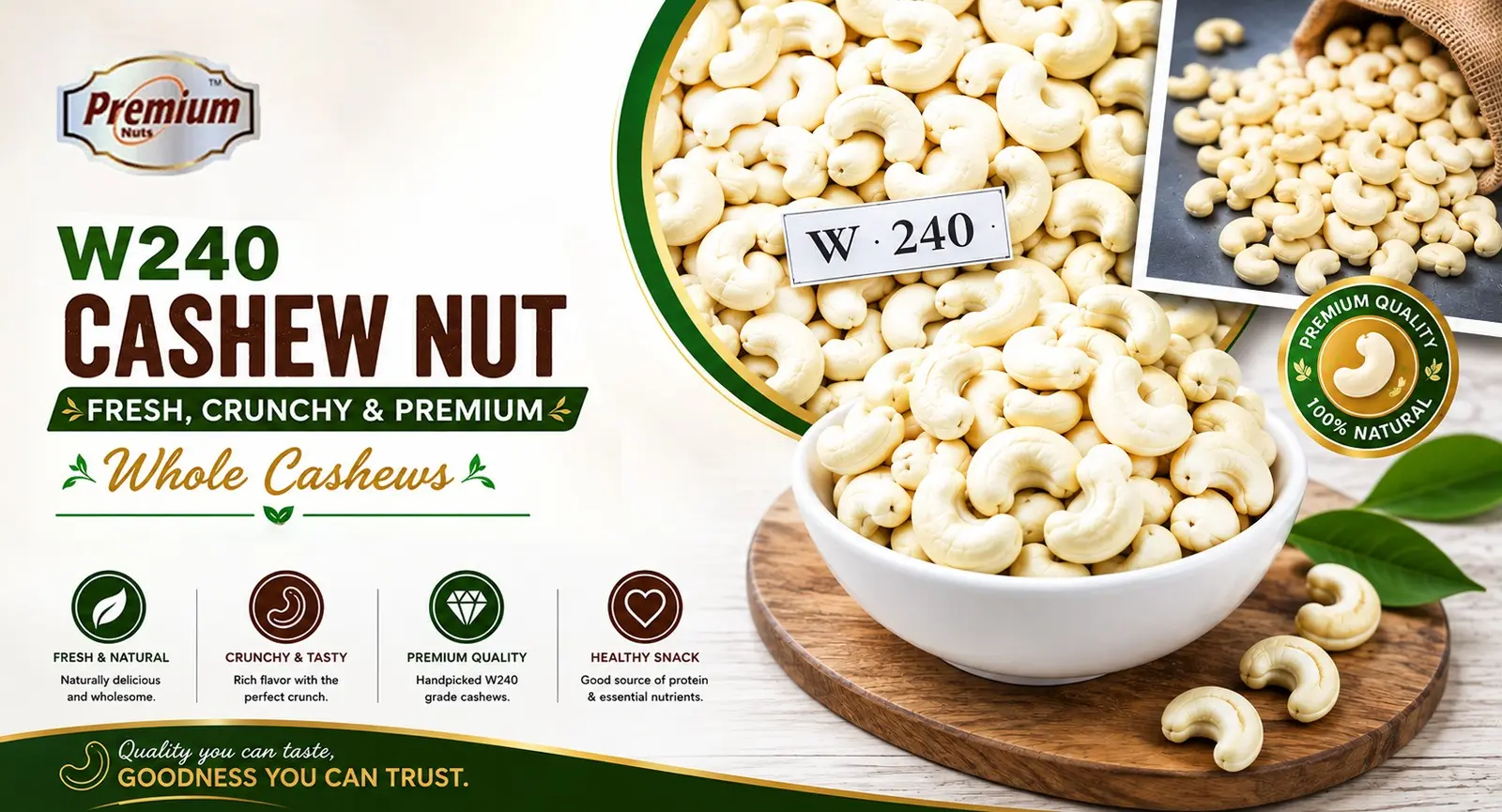
The term W240 Cashew Nut refers to a whole, white cashew kernel graded according to its approximate count per pound. The number “240” indicates that around 220 to 240 whole kernels are found in one pound, or approximately 485 to 530 kernels per kilogram. Because the kernels are whole and relatively large, W240 is commonly placed in the premium segment.
The letter “W” stands for white whole. It does not mean that every kernel must be bright white. A good lot may range from white to pale ivory, depending on origin and processing conditions. The important points are that the kernels should retain their natural shape, show good colour consistency, and have no strong signs of mould, rancidity, insect damage, or excessive scorching.
W240 is often chosen by buyers who want a balance between appearance, eating quality, and cost. W180 is larger and usually more expensive, while W320 contains more kernels per pound and is smaller. W240 Cashew nuts are between these grades, making it suitable for both premium retail packs and commercial food applications.
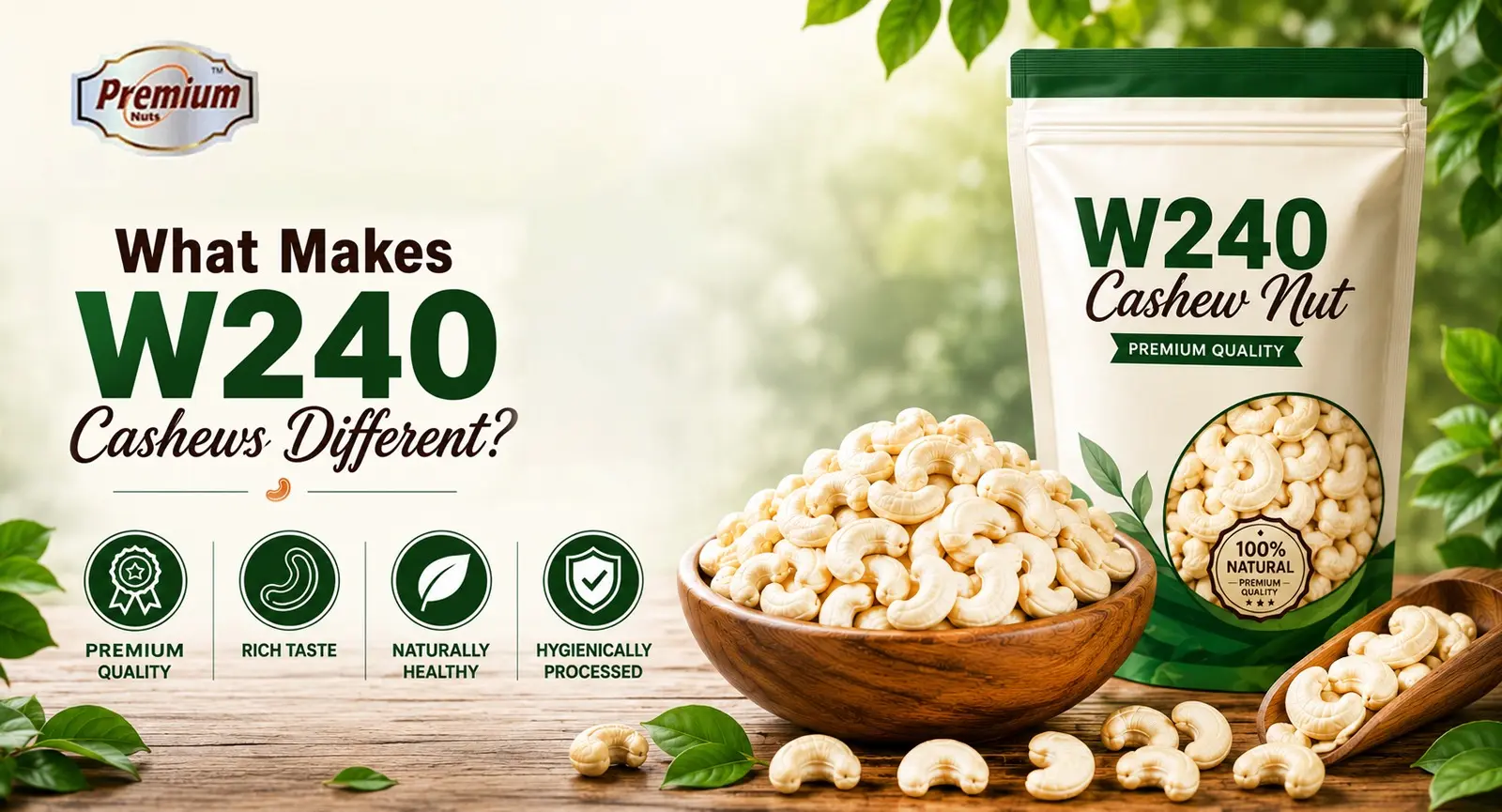
What Makes W240 Cashews Different?
Size and Appearance
W240 cashews come as whole kernels, with that curved shape people expect from a good-quality cashew. Their size makes them stand out in snack mixes, gift boxes, roasted nut packs, and anywhere the cashew itself is meant to be the star, not just filler.
For bulk buyers, consistency in size is worth paying attention to. If a shipment has too much variation in kernel size, it roasts unevenly, and the finished pack just doesn’t look as good. So before approving a consignment, check what percentage of smaller kernels, broken pieces, discoloured nuts, or surface damage is mixed in with the rest.
Crunch and Freshness
A fresh W240 cashew should snap with a firm, satisfying crunch once roasted, and carry a mild, slightly sweet flavour. If it tastes stale, oily, bitter, or comes out soft instead of crisp, that’s a red flag. Most of the time, it traces back to moisture getting into the kernel, which is exactly why proper drying and tight packaging matter so much.
A batch can taste great the moment it’s opened, and still go downhill later if the packaging lets in moisture or air. That’s the reason moisture levels, sealing quality, storage temperature, and how the shipment travels all matter just as much as the grade stamped on the bag.
Whole-kernel value
Whole cashews generally command a higher price than broken grades because they offer better presentation and more uses. They can be sold directly as snacks or used in products where the nut remains visible.
However, “whole” does not mean every kernel will be perfectly identical. Industry specifications allow limited defects, and acceptance levels can vary by buyer, market, and contract. Always agree on quality tolerances before placing a large order. AFI guidance classifies a kernel as whole when it retains its characteristic form and no more than a limited portion is broken.
Where W240 Cashew Nuts Get Used
This grade shows up across a wide range of applications:
- Retail snack packaging, where size needs to look generous without hitting premium pricing.
- Food service and catering, where consistent kernel size matters for plating and portioning.
- Baking and confectionery, where whole kernels are visible in the finished product.
- Gift and festive packaging, where W240 offers a premium look at a more accessible cost than W180.
- Culinary use in salads, stir-fries, and sauces, where the kernel’s creamy texture and crunch both matter.
The common thread across these uses is visibility. W240 cashew nuts are whole, well-formed kernels that work best where the nut itself is seen or tasted directly, rather than ground down or used purely as a filler ingredient.
What Makes W240 the Best Choice for Buyers
A few things make this grade a consistent choice across different buyer types, from retailers to food service operators.
- Works in retail and processing. W240 is a great standalone premium snack, and it holds up well if a business roasts, salts, or uses it in another product.
- Predictable ordering. Since the count-per-pound is standardized, a purchase order specifying W240 cashew nut should deliver comparable kernel size across different suppliers, not just within one relationship.
- Fits a wider budget range. Buyers who want a whole, well-formed kernel without stretching to W180 pricing find W240 covers most of that visual and textural expectation.
- Suits recipe-dependent businesses. Snack brands or bakers running standardized recipes need kernel size to stay consistent batch after batch, since a shift toward smaller nuts changes both appearance and how many kernels end up per package.
What to Check Before You Order W240 in Bulk
Grade alone doesn’t guarantee quality. A few things are worth confirming with any supplier before placing a bulk order:
- Color consistency. W240 cashew nuts should be a soft ivory shade; inconsistent coloring across a batch can indicate mixed processing quality or storage issues.
- Broken kernel percentage. Even within a “whole” grade, some breakage happens during handling. Ask suppliers what percentage of broken kernels is acceptable within a W240 order.
- Packaging and moisture content. Cashews are very sensitive to moisture, and poor packaging can severely limit their shelf-life. Vacuum-sealed or nitrogen-flushed packaging tends to travel better.
- The accreditation. Depending on the market you are in, check for FSSAI, FDA or DGFT certification. These certifications mean the supplier adheres to the food safety rules in your area.
- Batches over orders consistency. If you are a repeat buyer, ask if the supplier can keep the kernel count and quality consistent in multiple shipments, not just in one sample batch.
Moisture is especially important because excessive moisture can affect texture and storage stability. Some published specifications list a maximum moisture level of about 5%, but the agreed limit should be confirmed for the destination market and buyer’s requirements.
Food safety checks should also be discussed. Depending on the market, buyers may request testing for aflatoxins, microbial quality, pesticide residues, or other contaminants. Do not assume that every supplier follows the same testing schedule. Ask what is tested, how often it is tested, and whether reports relate to the actual batch being shipped.
Conclusion
Once you actually understand what W240 cashew nut means, buying cashews stops being a guessing game. It’s not a mystery code or a marketing label; it’s simply telling you the kernel size and count you’re paying for. That clarity makes comparing suppliers, prices, and quality far easier than trusting a number that sounds premium. R.K. Agro Processing has spent years working with this exact grade, and what buyers keep coming back for isn’t the label; it’s knowing each batch matches the last.
FAQs

R.K. Agro Processing
R.K. Agro Processing uses a production and packing system that meets the required standards to ensure the freshness and deliciousness of the cashews. Our company makes sure to comply with the regulations to guarantee the quality of the cashews.


